Genome sequencing nominates hundreds of candidate variants in neurodevelopmental disorders every year. Identifying one is only the beginning. For many genes we still cannot say whether reported variants actually disrupt human brain development, or how.
PPP1R9A, which encodes the neuron specific scaffolding protein Neurabin I, has been one of those genes. Rare variants appear repeatedly in individuals with developmental delay, autism spectrum disorder, intellectual disability and epilepsy. Direct evidence linking those findings to disease biology in human neurons has been missing.
The new PPP1R9A variant resolving study closes that gap, and the result matters well beyond a single gene.
A paradox in the dish
Using CRISPR-Cas9 editing, the investigators built a human stem cell model carrying a heterozygous loss of function mutation in PPP1R9A and differentiated it into cortical neurons. They then tracked reduced Neurabin I dosage from gene to protein to cellular function, combining electrophysiology, quantitative proteomics, long read single cell transcriptomics, pseudotime trajectory analysis and molecular rescue.
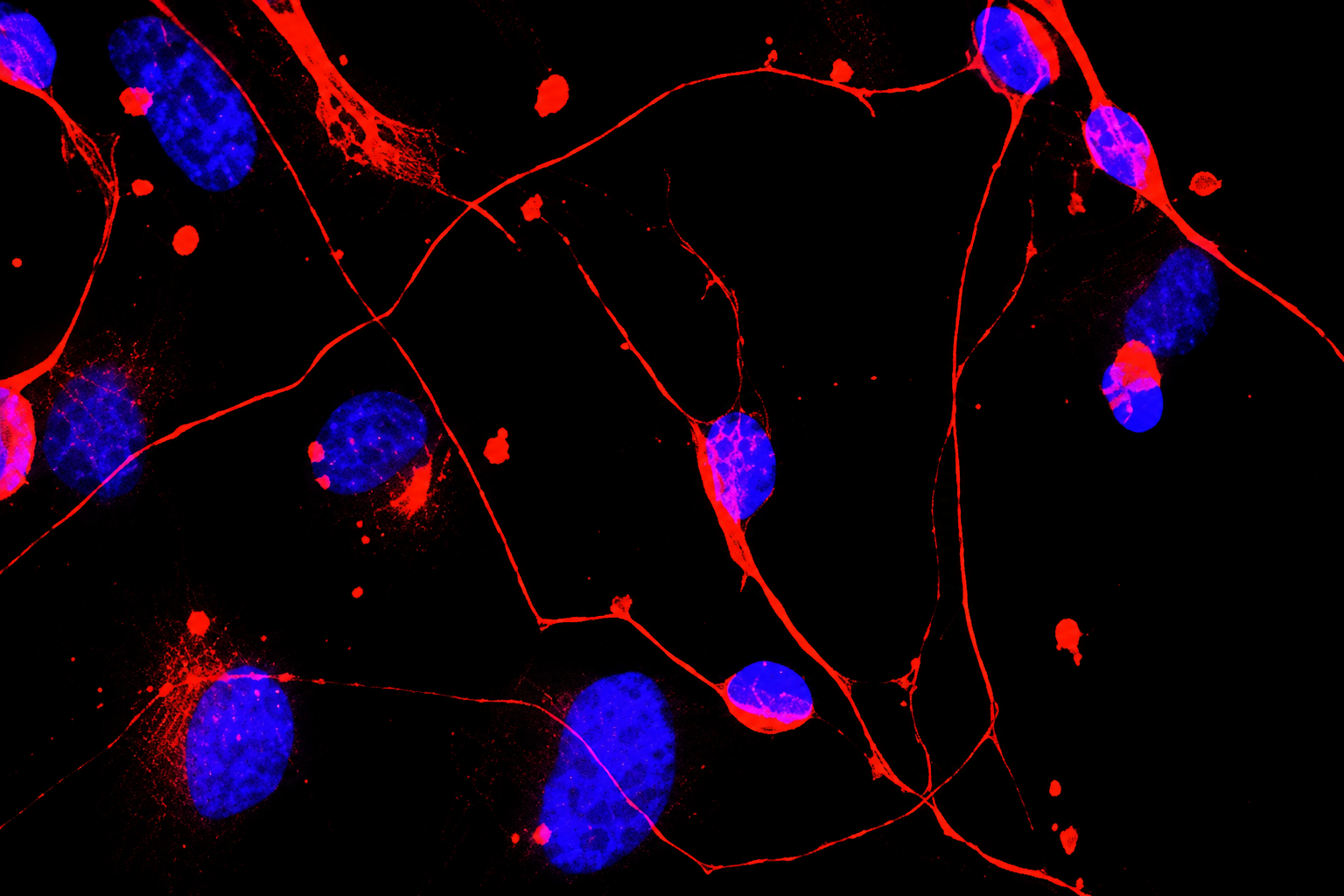
The first observation was unexpected. Mutant neurons grew larger, more elaborate dendritic arbors, the visual signature of enhanced structural maturation.
Function showed the opposite. These neurons generated action potentials inefficiently. Sodium channel recruitment was impaired, action potential kinetics were altered, and axosomatic coupling was defective. The cells looked more mature and behaved less so.
The increased structural complexity was not healthy maturation. It was an imbalance between neuronal growth and functional synaptic development.
Proteomics explained the paradox. Structural and postsynaptic proteins rose while the machinery of communication fell: the sodium channel subunit SCN3B, presynaptic components, calcium signalling proteins and the AMPA receptor subunit GRIA1. The scaffolding went up while the wiring fell behind.
Where the damage concentrates
Long read single cell transcriptomics added another dimension. Effects were highly cell type specific, hitting cortical excitatory neurons and neural progenitor cells hardest. Pseudotime analysis showed delayed progression toward mature neuronal states, alongside dysregulation of synaptic transmission, axon guidance, cytoskeletal organisation and PI3K–Akt and MAPK signalling. Many established neurodevelopmental disorder genes were perturbed simultaneously, placing PPP1R9A inside a broader regulatory network rather than acting alone.
Rescue experiments closed the loop. Allele specific antisense oligonucleotides produced only partial molecular recovery. Restoring full length PPP1R9A expression broadly normalised transcriptomic and proteomic signatures, including ion channel expression and synaptic signalling. Dosage, not mere presence, is what the neuron is sensitive to.
Why these variants were called uncertain
Here is what makes this study matter beyond its own findings.
Query these PPP1R9A variants in GenomeArc Horizon and the answer has been consistent: variant of uncertain significance. Not pathogenic. Uncertain.
There is a persistent temptation, when a gene carries a compelling biological story, to let the story pull the classification along with it. PPP1R9A had that story for years. Neuron specific. Synaptic. Recurrently hit in patients with developmental delay and epilepsy. Highly plausible.
None of that is variant level evidence. Gene plausibility is not an ACMG criterion. So the variants stayed at VUS, not because anyone doubted the gene mattered, but because the evidence that moves a specific variant had not been established.
A VUS is not a weak pathogenic. It is an accurate statement about the evidence at a moment in time, and an implicit promise that when the evidence changes, the classification changes with it.
This study is that change. Well established functional studies supporting a damaging effect are exactly what the PS3 criterion was written for. And PS3 is heavy.
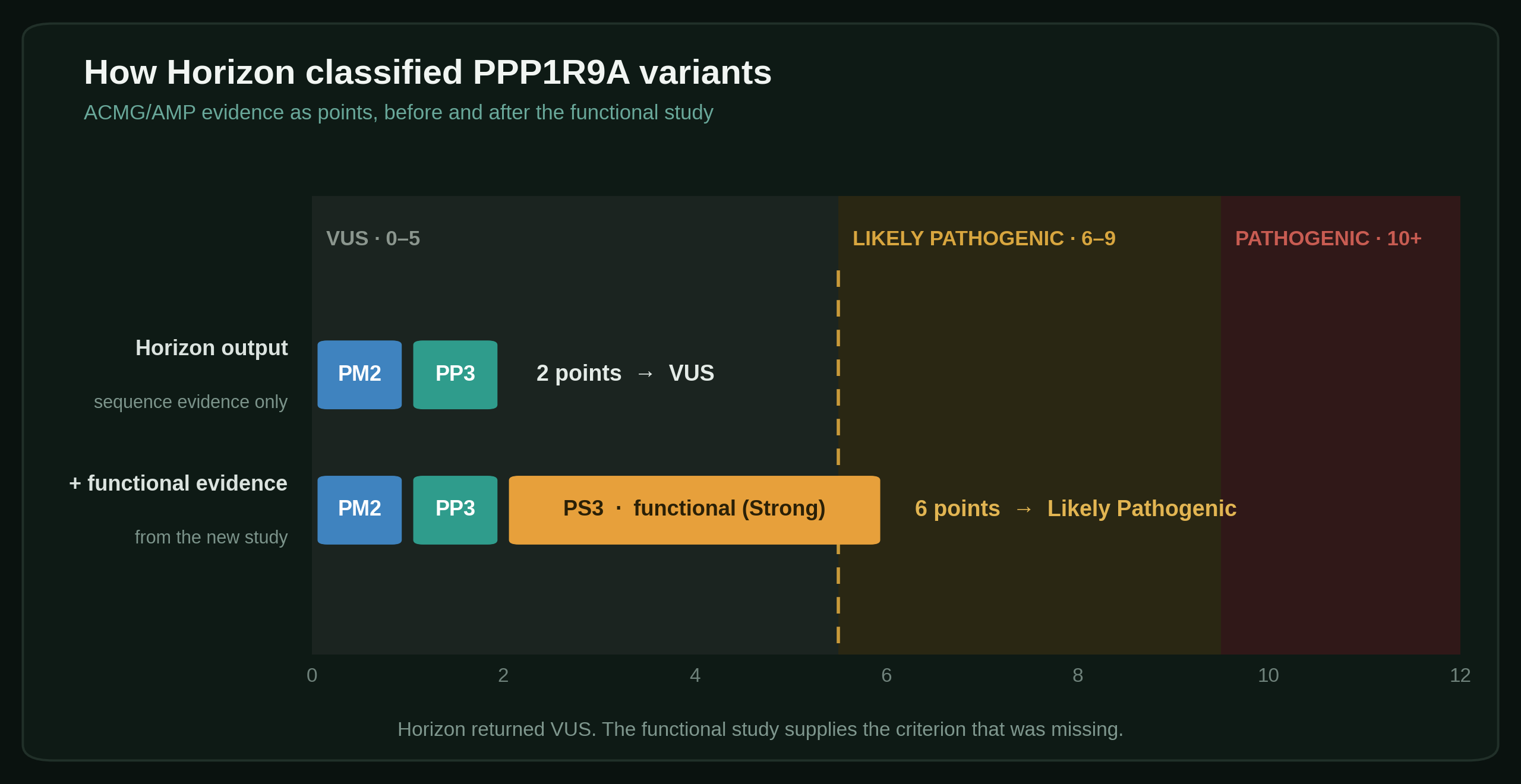
The reclassification, in one view. Horizon classified these PPP1R9A variants as uncertain on rarity and computational evidence alone, which leaves them well short of the threshold. A validated functional assay applied at Strong carries four points on its own, enough in combination to cross into likely pathogenic. Strength assignment depends on how thoroughly an assay is validated against known pathogenic and benign controls, per ClinGen Sequence Variant Interpretation guidance.
Why PS3 has to be earned. Functional evidence is not automatically Strong. ClinGen's SVI framework requires an assay to be validated against known controls before its strength is set, and many published assays support only Supporting or Moderate weight. The rigour here, with electrophysiology, proteomics, single cell transcriptomics and rescue all pointing the same direction, is what makes the higher strength defensible.
The discipline is the point
It would have been easy, and it would have felt clinically generous, to call these variants pathogenic three years ago. The gene was plausible. The patients were real. The story fit.
A platform that had done so would have reached today's answer by luck. It would also have been wrong wherever the functional data came back the other way, and those cases exist in every gene and every cohort. Families on the receiving end of a premature pathogenic call do not get the correction back.
Calling a variant uncertain when the evidence is uncertain is not caution for its own sake. It is the only honest output available at that moment, and it is what makes the eventual reclassification meaningful rather than arbitrary.
Reclassification is not a correction of an earlier failure. It is the framework doing what it was built to do.
As sequencing nominates candidate disease genes faster than biology can characterise them, work like this is what converts uncertain genetic findings into grounded mechanism. It lets a classification move for a reason, on a documented criterion, with the evidence trail intact behind it.
That is the standard worth holding. Not the platform that says pathogenic first, but the one that shows you exactly why, and exactly when, it changed its mind.
Every variant in GenomeArc Horizon returns its evidence codes alongside its classification, so when new functional data lands you can see precisely which criterion moved, and what it moved. Search a variant free →