Mississauga, Ontario
Many patients with a rare disease still leave genetic testing without a clear diagnosis, and many cancer samples are sequenced without finding the oncogenic driver mutation that causing the cancer progression.
In many cases, the problem isn't the sequencing itself, it's what clinician and researchers allign the sequence against. Standard pipelines align a patient's DNA to a single reference genome. If a stretch of DNA isn't in that reference, the pipeline simply can't detect it.
Global pangenome studies show just how much is missing. The Human Pangenome Reference Consortium found 119 million bases and 1,115 gene duplications absent from the reference [1, 2]. The Chinese Pangenome Consortium found 189 million missing bases across 36 ethnic groups [3], and the Arab Pangenome Reference identified 112 million missing bases along with 235,195 structural variants [4].
Ironically, the genes clinical labs test most often are the ones standard pipelines handle worst. Genes like SMN1/SMN2 (spinal muscular atrophy) are 99.9% identical, while STRC (hearing loss) and PMS2 (Lynch syndrome) are obscured by near-identical pseudogenes and gene conversion. So real, actionable mutations are simply filtered out. This isn't a sequencing failure; it’s an interpretation failure built into reference-based mapping.
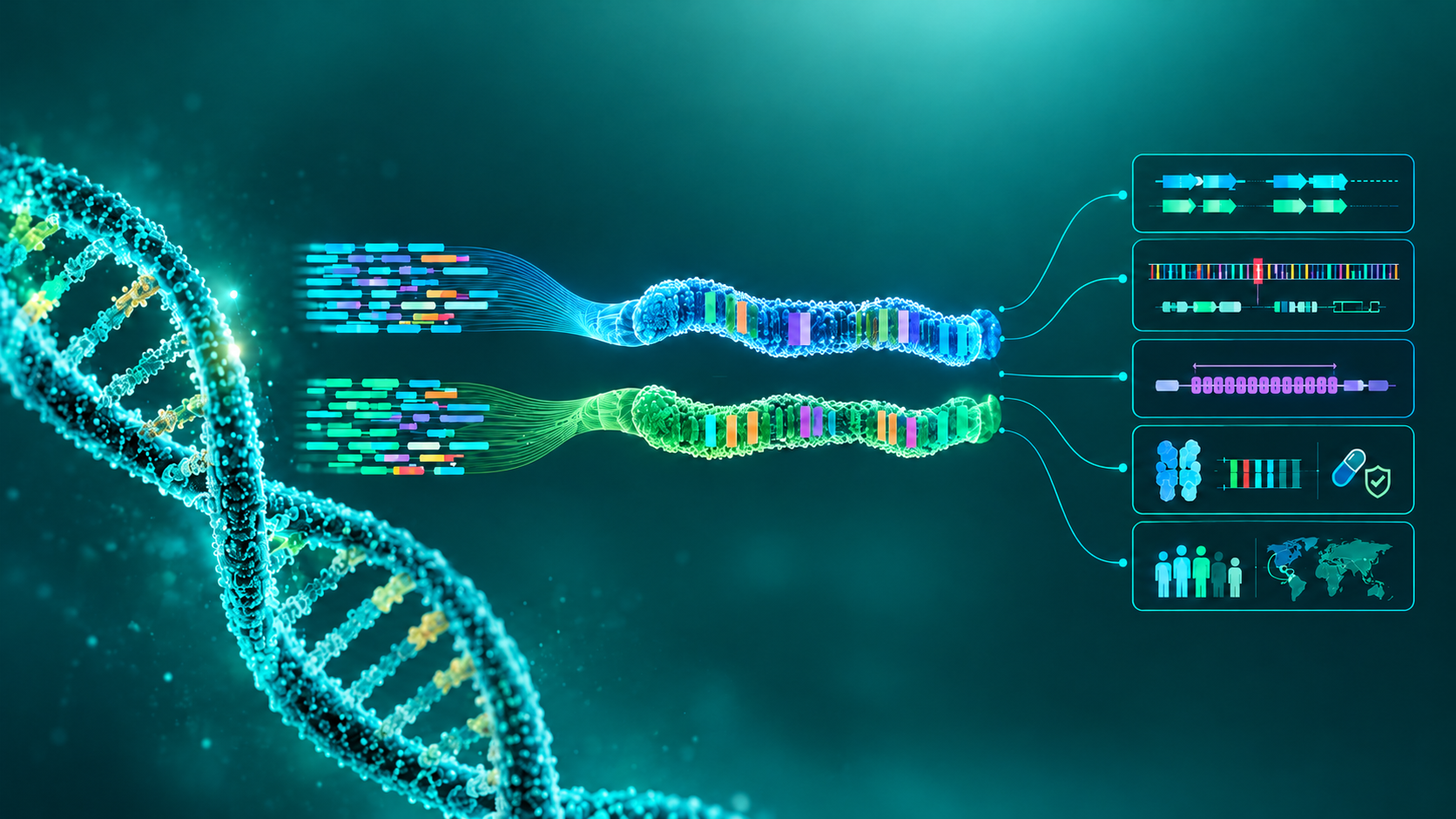
Today, long-read sequencing can assemble both copies of a patient’s genome from scratch. Phaser is the software we built to interpret them.
Phaser: assembly-based interpretation inside Horizon
Phaser is developed by GenomeArc and built into Horizon, our multimodal genome interpretation platform for rare disease and cancer. To our knowledge, it is the first assembly-based tertiary analysis engine: it interprets the patient's both parental assembled genomes directly, rather relying only on the reference genome.
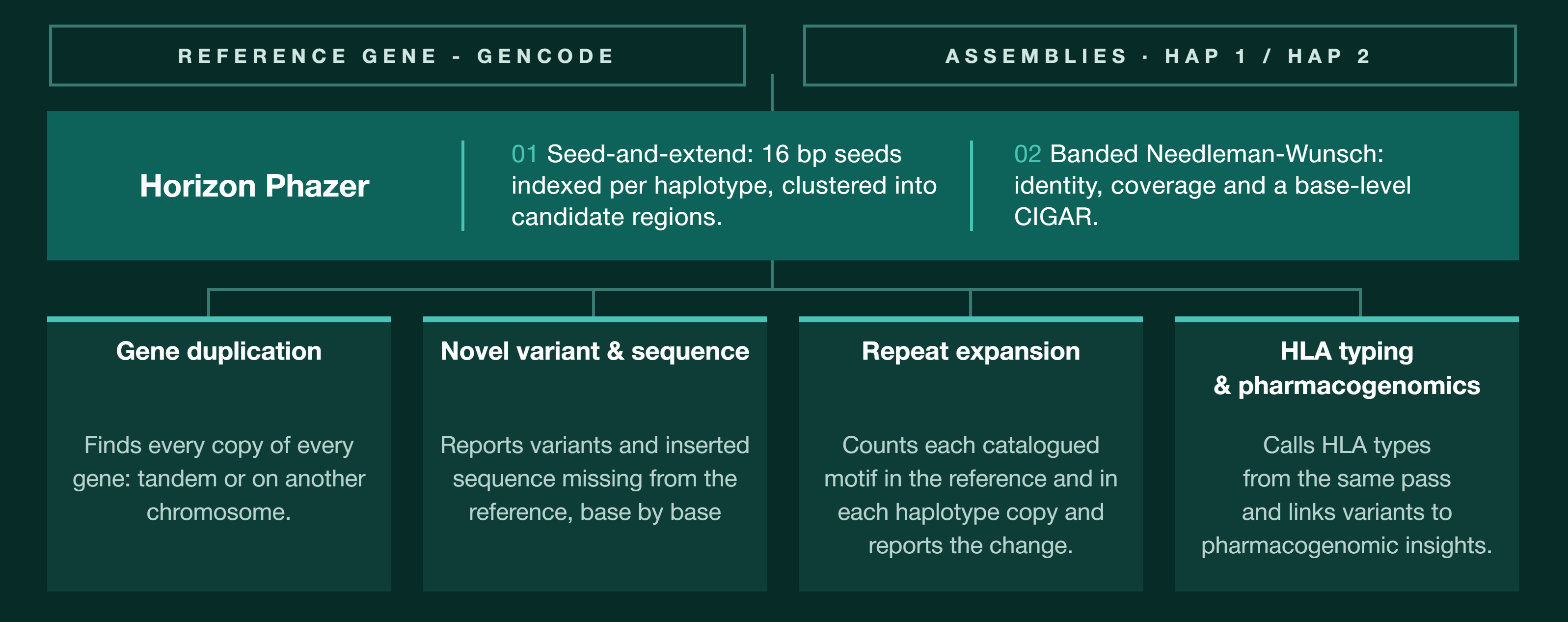
Phaser takes the two haplotype assemblies, hap 1 and hap 2, from any de novo assembler, including the two most widely used, hifiasm and Verkko [5, 6]. It first runs its own QC to confirm that each assembly is complete and accurate enough to interpret. It then annotates both haplotypes in full, with every gene and non-coding element in GENCODE [7], and compares them with the reference. Much of our development goes into the hardest parts of the genome, such as handling segmental duplications, the highly variable immune genes and long repeats, where reference-based methods struggle most. From that single analysis, Phaser reports four kinds of findings.
Gene duplications, counted and located
Extra copies of a gene can change how much protein a cell makes, and copy-number changes are a known cause of developmental and neurological disorders. With short reads, near-identical copies pile onto one reference position and blur together. Phaser finds every copy of every gene on each haplotype and reports how many there are, which parental copy carries them, and exactly where each one sits.
Novel variants and sequence beyond the reference
DNA that is in the patient but not in the reference has nowhere to land in a standard pipeline. By constructing personalized haplotypes, Phaser captures variants and sequences that conventional reference-based approaches may miss. Phaser compares each haplotype with the reference, gene by gene, and reports single-nucleotide variants, indels and structural variants, together with newly inserted sequence such as Alu elements. Because every variant is tied to a haplotype, it also shows when two damaging variants in a gene sit on different parental copies, the pattern behind many recessive diseases.
Tandem repeat expansions on each parental copy
Repeats such as the CAG repeat in HTT (Huntington's disease) or the intronic expansion in RFC1 (CANVAS) cause disease once they pass a threshold, yet expanded repeats are often longer than a short read. In an assembly the repeat is spelled out in full, so Phaser sizes it on each haplotype separately, for repeats up to 10,000 base pairs.
HLA and pharmacogenomic alleles
The HLA region and drug-metabolism genes such as CYP2D6 are among the hardest parts of the genome to read with short reads. Phaser calls HLA types and non-HLA pharmacogenomic alleles directly from each haplotype. Horizon links them to curated drug evidence, so the report shows what each result may mean for drug efficacy and adverse reactions.
Benchmarked, and built into Horizon
On the Genome in a Bottle benchmark samples, Phaser detected gene duplications with 99.2% recall and 99.9% precision and up to 10,000 bp tandem repeat can be detected. These findings are completely integrated with Horizon. Rare disease variants are classified under ACMG guidelines, cancer findings feed the tumour profile, and pharmacogenomic alleles link to drug evidence. Every call is weighed against GenomeArc's long-read population data from 10+ underrepresented populations.
References
- Liao WW, Asri M, Ebler J, Doerr D, Haukness M, Hickey G, et al. A draft human pangenome reference. Nature. 2023;617(7960):312-24. doi:10.1038/s41586-023-05896-x
- Human Pangenome Reference Consortium. HPRC data release 2, 2025.
- Gao Y, Yang X, Chen H, Tan X, Yang Z, Deng L, et al. A pangenome reference of 36 Chinese populations. Nature. 2023;619(7968):112-21. doi:10.1038/s41586-023-06173-7
- Nassir N, Almarri MA, Kumail M, Mohamed N, Balan B, Hanif S, et al. A draft UAE-based Arab pangenome reference. Nat Commun. 2025;16. doi:10.1038/s41467-025-61645-w
- Cheng H, Concepcion GT, Feng X, Zhang H, Li H. Haplotype-resolved de novo assembly using phased assembly graphs with hifiasm. Nat Methods. 2021;18(2):170-5. doi:10.1038/s41592-020-01056-5
- Rautiainen M, Nurk S, Walenz BP, Logsdon GA, Porubsky D, Rhie A, et al. Telomere-to-telomere assembly of diploid chromosomes with Verkko. Nat Biotechnol. 2023;41(10):1474-82. doi:10.1038/s41587-023-01662-6
- Frankish A, Carbonell-Sala S, Diekhans M, Jungreis I, Loveland JE, Mudge JM, et al. GENCODE: reference annotation for the human and mouse genomes in 2023. Nucleic Acids Res. 2023;51(D1):D942-9. doi:10.1093/nar/gkac1071